
 364.18


Armenia shows political will to approach the European Union, we are ready to deepen cooperation: MEP

9 minute read
The Democracy Support and Election Coordination Group (DEG) has been operating within the European Parliament since 2019. The group’s goal is to promote democracy in non-EU member states.
Each year, a decision is made on which countries the group will operate in. DEG’s activities mainly focus on the EU’s Eastern and Southern Neighborhood countries, the Western Balkans, and Turkey.
This year, Armenia has been chosen as a priority country, and DEG’s activities there will be led by Spanish MEP Nacho Sánchez.
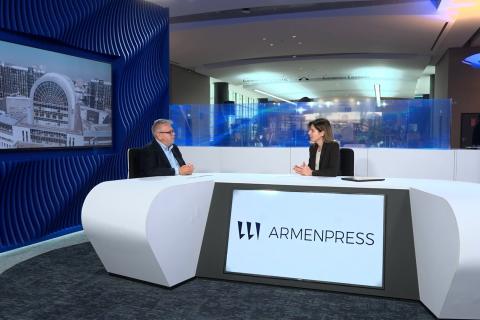
Armenpress' Brussels correspondent interviewed Member of the European Parliament Nacho Sánchez about DEG’s goals, its main areas of activity, the state of human rights and democracy in the South Caucasus in that context, as well as the annual session of the EURONEST Parliamentary Assembly, which will be held in Armenia at the end of October 2025.
-Mr. Sanchez, what functions does the DEG group have, what is the purpose of creating such a group, and what expectations are there from its activities?
-Well, the DEG is the unit of the European Parliament devoted to the promotion of democracy in the world. This is not related to liberties inside the European Union. It is linked to the AFET Committee and the DEVE Committee, and it’s a group devoted to the promotion of democracy in general.
There are many, many aspects, and every year we decide which countries we want to work with. Armenia has been selected as a priority country.
Being a priority country, my colleagues decided to task me with being the lead member of the DEG, meaning I am the face of this part of the world in the Parliament related to your country.
What do we do? Mainly, we focus on working with the Parliament of your country — the National Assembly — with groups in terms of mediation, facilitation, promoting the work of young leaders, and promoting the women’s caucus.
It is focused on Parliament, and collaterally on political parties, but it is not a kind of rapporteurship examining the whole country. It is very focused on inter-parliamentary connections and work devoted to the promotion of democracy.
-As you said, one of the DEG’s priorities is safeguarding democracy and human rights, which also extends to cultural rights. How can the EU respond to the documented destruction of Armenian cultural heritage in Nagorno-Karabakh under Azerbaijani control?
-We have mentioned the issue in many resolutions in the past. Unfortunately, this is one of the consequences of conflicts in many parts of the world.
The Parliament always underlines the need to preserve cultural heritage — it is not about stones, it’s about identity.
For that reason, we know for sure that this is a very sensitive issue, and we always try to address this part of the conflict, as has been the case for Armenian heritage in the Nagorno-Karabakh area and in some parts of Turkey.
-As a member of the DEG, how do you assess the ongoing illegal detention of Armenian hostages in Baku? Should the European Parliament play a stronger role in ensuring their release under international humanitarian law? Do you see scope for the DEG to use its mediation and dialogue mechanisms to pressure Azerbaijan to comply with international standards on political prisoners and detainees?
No, it is not part of the agenda. It is part of the general concern of the European Parliament regarding the situation.
We know that there is a commitment by President Trump to tackle the issue. And I can imagine your country, especially your country, is trying to push this part of the agenda, because Armenia has been very cooperative and has made efforts with some political cost.
Now I think you are entitled to demand that the mediator — in this case, President Trump — to comply with his commitments to do something for the release of the political prisoners and local authorities from Nagorno-Karabakh.
-Over one hundred thousand Armenians were displaced from Nagorno-Karabakh. How can the EU better balance humanitarian aid with political pressure, so that Armenian displaced communities do not remain permanently uprooted?
Yes. Whatever the outcome from the legal or political point of view — because this case is very political — the humanitarian situation of these people must be protected anyway.
Even if there is no commitment from Mr. Trump, or no prospects — luckily, we do have some — their humanitarian situation must be protected in any case, because every country, including Azerbaijan, is bound by international obligations regarding such prisoners.
-The DEG is meant to reinforce parliamentary democracy beyond the EU. Could Armenia’s democratic reforms and commitment to rule of law be more strongly supported by the EU as a counterweight to authoritarian pressures in the region?
-Not only to counter authoritarian trends, but also to counter the lack of American funding.
Armenia has lost an enormous amount of resources devoted to democracy and human rights since the Trump administration decided to completely cut U.S. aid.
This is a problem the European Union faces all around the world — we are not able to fully replace what the Americans used to fund.
But we are ready to engage with Armenia, because your country shows political will to approach the European Union.
For that reason, we are ready to engage in any aspects — mediation, facilitation, the promotion of democracy, even practical parliamentary work — with help not only from the European Parliament, but also from the national parliaments of our member states.
-The Euronest meeting in Armenia provides a platform for dialogue. What specific outcomes would you personally like to see regarding Armenia-Azerbaijan relations and the EU’s role in securing peace and justice in the region and especially between these two countries?
-Euronest is a gathering of parliamentarians from partner countries. In recent times, it has faced a very bumpy period for many reasons — Belarus is not participating for political reasons, Ukraine is at war, Moldova is having elections, Georgian authorities are clearly diverging from the European path, and Azerbaijan has the well-known problems related to democracy.
In this context, Armenia stands out as a bubble of relative stability. For that reason, I think it is good that Yerevan is the place to host this Euronest session.
However, the environment is not very conducive for progress for many reasons. Still, it is important to hold Euronest — to recommit every parliament and parliamentarian to our common goals of advancing neighborhood policies.
Some of these countries will become candidates, others not, but they are all working toward the European path — as is the case for Armenia.
This meeting is an excellent opportunity to assess each country’s level of commitment and political will regarding rapprochement with the European Union.