
 363.52


Connor Chard: “We are building Amulsar’s digital foundation from the ground up”
9 minute read

Modern mining is difficult to imagine without digital technologies, data, and innovative solutions. However, simply adopting new technologies does not necessarily lead to effective digitalization. What matters is how these technologies are integrated into a mine’s overall operating system and how the data collected is transformed into actionable insights that support decision-making.
Lydian Armenia aims to establish Amulsar as a fully integrated and connected digital mining operation from the very start of operation. The Club of Economic Journalists spoke with the company’s General Manager, Connor Chard, about Amulsar’s digital strategy, data management, the challenges of digital transformation in the mining industry, and the foundations required to unlock the potential of artificial intelligence.
– Mr. Chard, as a new mining project, what opportunities does Amulsar offer from a digitalization perspective?
– As you know, Amulsar is the first and, to date, the only metal deposit discovered in Armenia since independence that is now approaching the start of operations. From a digitalization perspective, this gives us a significant advantage.
In existing mining operations, new technologies often need to be adapted to infrastructure, systems, and workflows established years ago. At Amulsar, we have the opportunity to design the digital environment from the outset and embed it as an integral part of the mine’s operating model.
In other words, we have the opportunity to build Amulsar’s “digital backbone” from the ground up, creating the foundation for a fully integrated digital ecosystem.
– What is Lydian Armenia’s digital vision for Amulsar?
– The full digitalization of Amulsar is a key priority for us. We are already actively working toward this goal so that, from the start of operations, the mine can function as a fully integrated and connected digital operation.
For us, a digital mine is much more than a collection of individual technologies or software solutions. Our goal is to connect the entire mining value chain within a single digital environment—from equipment and field operations to planning, management, and decision-making.
This approach enables us to turn data and technology into practical tools that improve operational efficiency and support faster, data-driven decision-making.
– You mentioned an “integrated digital system.” What does this mean in practice?
– Our approach is built around four core principles.
The first is system integration, ensuring that different functions are connected rather than operating in isolation.
The second is to automate workflows and capture data directly at the source—whether from equipment, sensors, employees, or operational systems.
The third is establishing clear accountability and consistent standards. There must be clarity around who is responsible for the data, how it is managed, and what standards it must meet.
And the fourth is turning reliable data into actionable insights.
Together, these four principles will provide our team with reliable, actionable information to improve production, manage impacts and costs, and enable data-driven decision-making.
Our team also brings extensive international experience. Many of our specialists have previously worked in similar operating environments and with comparable technologies, and we are now applying that expertise at Amulsar.
– What are the main challenges mining companies face on their digital transformation journey?
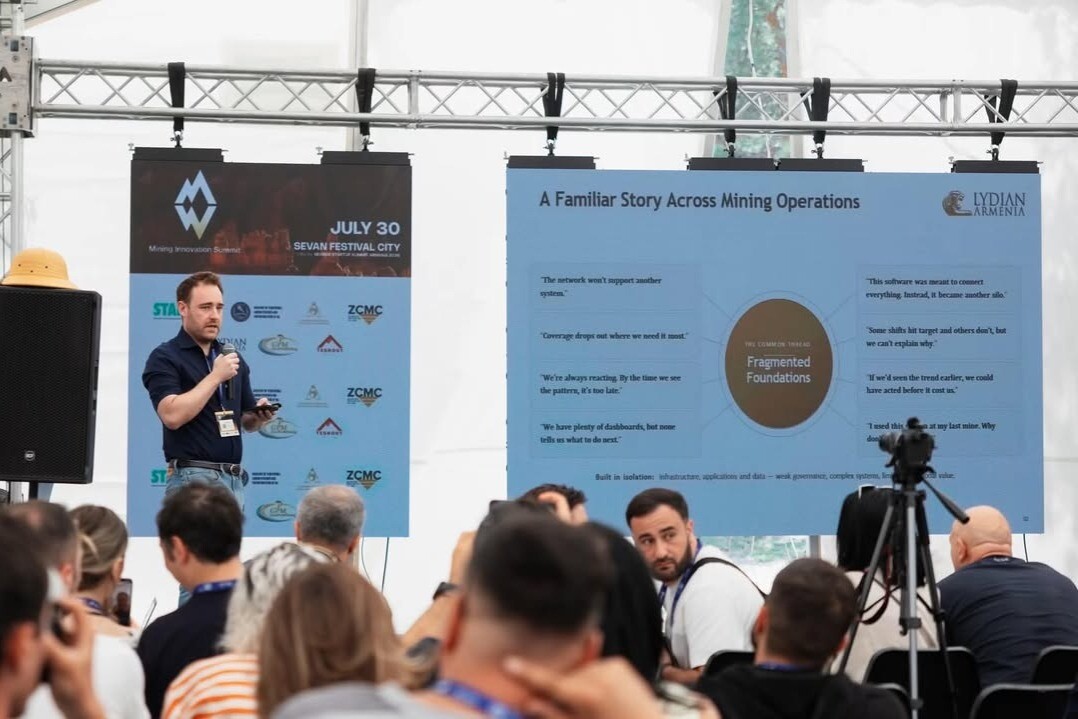
– Throughout my career, I have seen mining companies introduce new technologies into systems and operating environments that were never designed to accommodate them.
Companies can invest significant resources and deploy numerous systems and software solutions while generating vast amounts of data. But having more technology and more data does not, in itself, translate into greater operational efficiency or better decision-making.
The underlying challenges are often fundamental: inadequate infrastructure, incomplete or unreliable data, siloed systems, limited integration, and unclear accountability.
Under these conditions, even the most advanced technological solution may fail to deliver the expected results.
Technology creates real value only when it is properly integrated into the broader operating system, aligned with actual workflows, and enables people to make faster, more accurate, and data-driven decisions.
– How important is data within this system, and how will it be collected, managed, and used?
– Data is the foundation of the entire system. Data collection begins at the source—whether that source is equipment, a person, a sensor, or an operational system.
The data then moves through a controlled process into a single, governed platform, where it can be validated, integrated, and made accessible to the people who need it.
Our goal is to transform raw operational data into consistent, reliable, and actionable information.
This enables better decision-making today while also creating the foundation for advanced analytics and AI-driven predictive capabilities in the future.
– Artificial intelligence is now a key part of the digital agenda across nearly every industry. What role do you see it playing in the future of mining and, specifically, at Amulsar?
– Despite significant investment in recent years, the mining industry still has considerable work ahead on its digital transformation journey. Data quality remains a persistent challenge, while many technology investments have yet to deliver the results originally expected.
At the same time, mining companies are preparing to significantly increase their investment in artificial intelligence. AI undoubtedly has enormous potential, but without a strong digital foundation, it cannot deliver meaningful value.
If systems are not connected and the underlying data is incomplete or unreliable, AI will simply generate answers faster based on poor-quality information.
That is why, before focusing on the potential of AI, we need to make sure the right digital foundations are in place. This is exactly where our efforts at Amulsar are focused today.
– Once Amulsar becomes operational, how will this digitalization translate into the mine’s day-to-day operations?
– Technology itself is not the end goal. The goal is to make the mine more efficient, predictable, and effective in its day-to-day operations.
When people have timely access to reliable information, systems are connected, and workflows are streamlined and automated wherever possible, we can gain a clearer, real-time understanding of what is happening across the operation and make faster, better-informed decisions.
This should help us manage production and costs more effectively, respond more quickly to changing conditions, and ultimately improve the quality of decision-making across the operation.
Our goal is for Amulsar’s digital system to go beyond simply showing us what has already happened. Over time, it should help us better understand what is happening now and anticipate what is likely to happen next.
That is where the real value of digitalization lies.