
 363.52


More countries need to recognize Armenian Genocide to put that pressure on Turkey – IAGS President
10 minute read

YEREVAN, DECEMBER 15, ARMENPRESS. Melanie O’Brien, President of the International Association of Genocide Scholars (IAGS), Associate Professor of International Law, stresses the need for more countries to recognize the Armenian Genocide, putting pressure on Turkey so that it acknowledges the fact that genocide took place in 1915. The Professor also highlights the recognition of the Armenian Genocide for preventing future genocides.
“There are countries that have outlawed denial of particular genocides, so for example, denial of the Holocaust”, she said in an interview to ARMENPRESS, touching upon Turkey’s policy of denial. “But we don’t see that being implemented with regards to the Armenian Genocide. Because when you think about the Holocaust, there is no state that denies the Holocaust happened. Germany which is the perpetrator state, has acknowledged it, has taken responsibility, memorializes it, has museums and has taken the right steps. So, the deniers of the Holocaust are individuals. This is a different situation. Here we have a state, we have Turkey that is denying that”, she added.
According to the IAGS President, denial isn’t a law issue, it’s a moral issue.
“The legal challenge is of actually prosecuting someone for what the state is done, is obviously a completely different scenario from prosecuting one historian who denies that Holocaust took place, it’s very very different”, she notes.
When asked whether the recognition of the Armenian Genocide is important for preventing new genocides, she stated: “Absolutely, because recognition is about acknowledging what took place, it’s also about healing, memorializing. So, at the moment Armenians can’t really access Turkey, and they can’t access their cultural heritage that’s in Turkey because of this denial and because of that fractured relationship between Armenia and Turkey as a consequence of that denial. And that means that there is no memorialization at Armenian sites in Western Armenia and Eastern Turkey. Memorialization is part of education, a really important part of education, and education is a really important part of prevention. So, that’s where the connection is. If you think about the Holocaust, you can go to visit Holocaust sites, you can visit camps. And people visit those sites and they learn about the Holocaust, they learn what happened, and that education is an essential part of prevention. But for the Armenians, we have Tsitsernakaberd in Armenia, but when we are thinking about the locations of where the Genocide took place, there is location in current Eastern Turkey. And we are unable to memorialize those locations and use them for memory and also for educational purposes”.
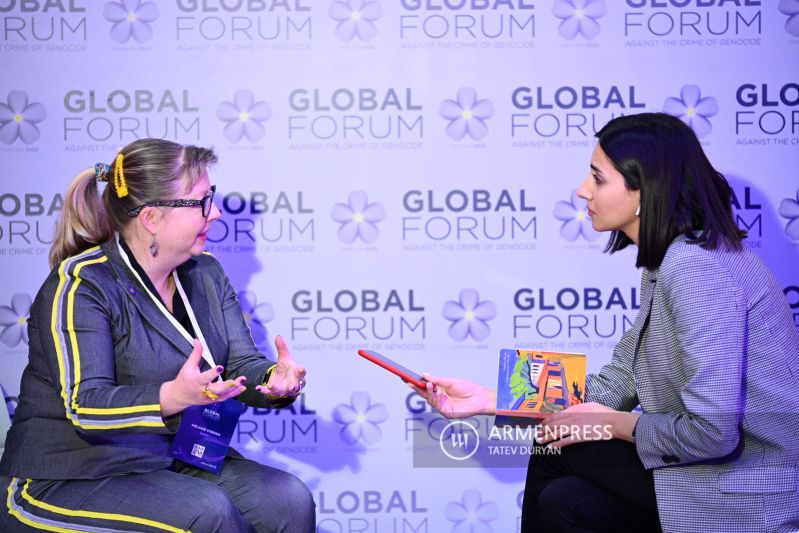
As for what is the role of the international community to force Turkey to recognize the Armenian Genocide, Melanie O’Brien said that the international community does need to do more. She said that there are countries that have recognized the Armenian Genocide, including the United States, which she called really important, but added that there are also countries that haven’t. As an example, she mentioned Australia that has not recognized the Armenian Genocide.
“There is a very interesting relationship between the Armenian Genocide and Australia, because we had in World War I at the same time the battle of Gallipoli in Turkey where many Australians were killed. This is a very significant battle in the Australian military culture. It is commemorated on Anzac Day every year, which is the 25th of April, which is obviously very close just to the day of the commemoration of the Armenian Genocide. So Australians were in Turkey at the time, and there are Australians who witnessed what was happening in the Armenian Genocide. There were Australians who rescued Armenians, rescued Greeks during this time. So we have quite a strong connection, but what’s interesting is that, because the Battle of Gallipoli is so significant in Australian culture, every year many people from Australia go to Gallipoli in Turkey to commemorate this. And Turkey has threatened Australia that if Australia recognizes the Armenian Genocide, they will prevent Australians from visiting Gallipoli to commemorate those Australians who were lost. I think this is really an interesting situation because here we have Australians who are able to go to that locations and commemorate the people that they lost, while Armenians are not able to do that”, she stated.
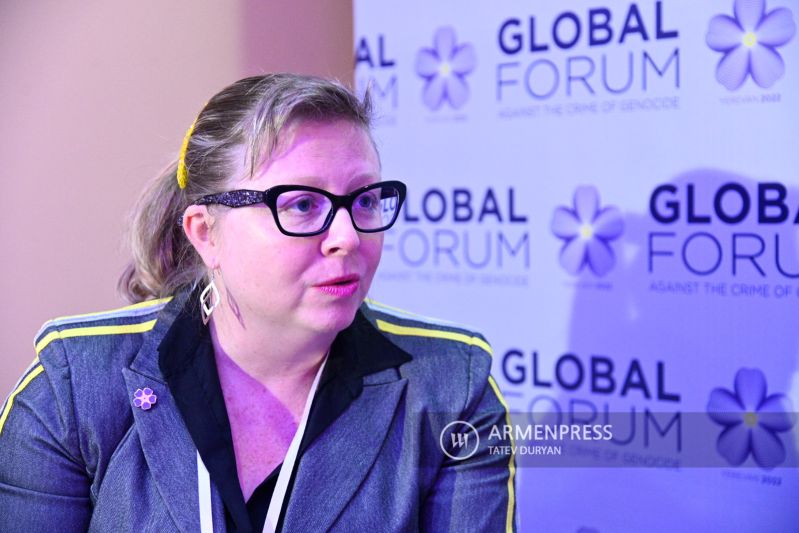
The IAGS President said that Australia does not have a strong trade relationship with Turkey and a large Turkish population in Australia. “We do, however, have a very large Greek population, a significant Armenian population and a small Assyrian population. So together they are quite a substantial population in Australia. It remains unclear to me why the Federal Australian government is not recognizeingthat because there isn’t a trade relationship, because there isn’t a large Turkish community. More countries need to recognize the Genocide to put that pressure on Turkey, say actually it was a genocide, we all say it was a genocide, so you need to do that. The only thing that I don’t think under Erdogan that recognition will happen. Erdogan is authoritarian, he violates the human rights of his own citizens, so I cannot see recognition occurring at any point while he is still in power. There needs to be a transition in power at a minimum for us to be able to think that recognition might be possible”, Melanie O’Brien emphasized.
Melanie O’Brien arrived in Yerevan recently for the participation in the 4th Global Forum Against the Crime of Genocide, which this year was dedicated to the prevention of genocides in the era of new technologies. The Forum discussed how new technologies – the internet and social media, are being used as a mean to disseminate hate speech, which is a significant factor in the genocide process.
“We often think about genocide as just a killing, but it’s absolutely not, and a hate speech is an essential part to disseminate amongst the majority population this perception that the victim group is the enemy that must be eliminated. And it creates the atmosphere and it creates the social pressure that ultimately makes it acceptable in the end to physically eliminate that group”, she said.
Melanie O’Brien emphasizes that states, countries need to take more action. “They need to be more definitive whether on an individual level, for example, implementing sanctions against the offending regime or through the United Nations. There is too much fear about jeopardizing relations, in particularly trade relationships, there is too much fear about not being able to access resources that are in the ground in a particular country. We need to stop prioritizing money so much and think about protecting people. Governments essentially need to have more courage and they need to prioritize standing up against regimes”, she stated.
The genocide scholar called the Forum held in Yerevan a fantastic initiative as, she says, it brings together scholars, UN representatives, government representatives, NGO representatives, policymakers, mainly people from all of different areas who work on genocide prevention, punishment and education.
“It brings them together in one place to have a discussion and to network and to really talk about what are we doing, how can we work together on this. And I think that’s really important because we are spread around the world and we do work in different fields, but we are all aiming for the same outcome in the end which is to prevent future genocides”, Melanie O’Brien said.
Interview by Anna Grigoryan
Photos by Tatev Duryan