
 362.34


First EU-Armenia Youth Forum spotlights young people’s participation
4 minute read
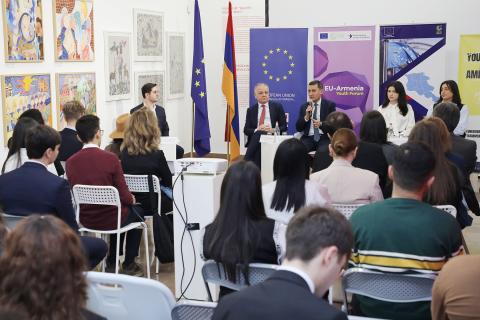
Armenian officials and the EU Ambassador to Armenia, Vassilis Maragos, attended the first EU-Armenia Youth Forum, organized by the EU Delegation in Armenia and the EU Youth Advisory Council (YAC) in cooperation with the Goethe-Institut Armenia, the Ministry of Education, Science, Culture, and Sports said in a press release.
As part of the forum, a panel discussion titled “Youth at the Center: Shaping the Future of Armenia-EU Cooperation through Dialogue and Action” was held, attended by Armenia’s Deputy Minister of Education, Science, Culture, and Sports, Artur Martirosyan; the EU Ambassador to Armenia, Vassilis Maragos; the Director of the Goethe-Institut Armenia, Dr. Jan-Tage Kühling; and other officials.
Deputy Minister Artur Martirosyan delivered a welcoming address, emphasizing the importance of the event as a distinct component of the Armenia–EU cooperation agenda.
“I consider the organization of this forum particularly significant in the context of the Armenia–EU agenda. There is active cooperation, especially through regional programs supported by the EU Delegation and within the framework of the Comprehensive and Enhanced Partnership Agreement (CEPA). At the same time, dialogue is conducted with development partners in various formats, focusing on culture, education, and youth. As a democratic country, Armenia places great importance on ensuring high levels of youth participation in various processes. Therefore, in addition to the unified platform for the publication of bills—where everyone can submit their opinions and proposals—participation in decision-making processes is also ensured through various discussions and meetings. The Youth Forum is yet another platform to make the voices of young people heard during important decision-making processes and to take their proposals into account.”
The Deputy Minister also presented the state policy aimed at establishing youth centers in Armenia’s regions. He provided a detailed overview of the centers’ roles and activities, noting that they are designed to develop young people’s skills, give them a platform to voice concerns, organize intellectual leisure activities, foster active citizenship, and more.
Concluding his remarks, Martirosyan called on young people to be active and to take advantage of various platforms to present proposals, which will be incorporated into state policy.
EU Ambassador Vassilis Maragos also addressed the audience, emphasizing:
“It is essential to ensure that young people—especially those from less advantaged groups—have full opportunities for self-realization: to recognize their potential, clearly articulate their needs, develop relevant skills, and participate effectively in dialogue and decision-making processes. Our goal is to ensure that everyone has a dignified place and that no one is left out of consideration.”